

- What is portable Windows 11/10 (Windows 11/10 To Go)?
- Selecting the best tool for creating portable Windows 11/10 workspaces.
- Step-by-Step Guide: Creating a Portable Windows 11/10 USB Drive Using Hasleo WinToUSB.
- Boot and Run Windows 11/10 directly from the portable drive.
- Why Choose Hasleo WinToUSB
- Troubleshooting
- Frequently Asked Questions
- Summary
Creating a portable Windows 11/10 USB drive lets you carry a full Windows environment in your pocket and boot it on any computer. Whether you need Windows for work, school, or specialized software, a portable Windows drive eliminates the need for dual-boot setups or carrying a separate laptop. This guide walks you through everything you need to know using Hasleo WinToUSB — the most powerful third-party tool to create Windows 11/10 To Go (even after Microsoft discontinued official support).
What is portable Windows 11/10 (Windows 11/10 To Go)?
Windows To Go is a "portable Windows" feature officially launched by Microsoft. It helps you install a complete Windows 11/10 system into a USB drive and ensures you can boot Windows from that USB drive, and the portable Windows system can boot on any computer. The core functionality of Windows To Go enables a portable Windows workspace that can boot on different computers, allowing users to maintain a consistent working environment across locations (e.g., home, office, or campus). Learn more about Windows To Go, please refer to: What is Windows To Go?
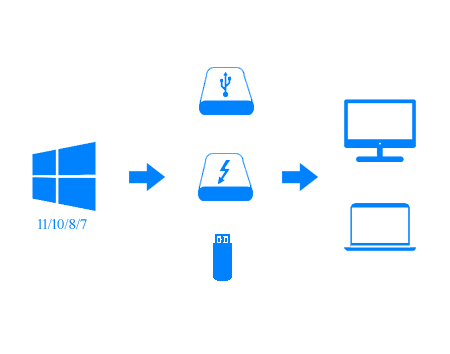
Have you ever imagined creating a portable Windows 11/10 on a USB drive and running Windows directly from it? Unfortunately, this feature was only available in Windows 10 Enterprise editions prior to 2019, as Microsoft discontinued Windows To Go development in 2019, and most users neither have Windows 10 Enterprise edition nor certified Windows To Go drives. Currently, creating Windows To Go workspaces requires third-party tools like Hasleo WinToUSB.
Selecting the best tool for creating portable Windows 11/10 workspaces.
Hasleo WinToUSB is the world's first third-party software for creating portable Windows. In recent years, other tools for creating portable Windows installations have emerged, including Rufus, AOMEI, and EaseUS. However, WinToUSB remains the most powerful portable Windows creation tool. It supports: creating portable Windows from ISO/WIM/VHD(X) files or CD-ROM, cloning currently running Windows installations to USB drives as portable Windows, creating BitLocker-encrypted Windows To Go workspaces, and building portable Windows systems from Hasleo Backup Suite's image files. Learn more: Why Choose Hasleo WinToUSB for Portable Windows Creation.
As the best portable Windows creation tool, WinToUSB supports installing any Windows 11/10 version on both certified and non-certified USB drives as portable Windows. After creating a Windows 11/10 To Go with WinToUSB, you can install applications and copy files to the drive. You now have a fully functional Windows 11/10 system bootable from a USB drive, allowing you to use it on any computer anywhere.
Step-by-Step Guide: Creating a Portable Windows 11/10 USB Drive Using Hasleo WinToUSB.
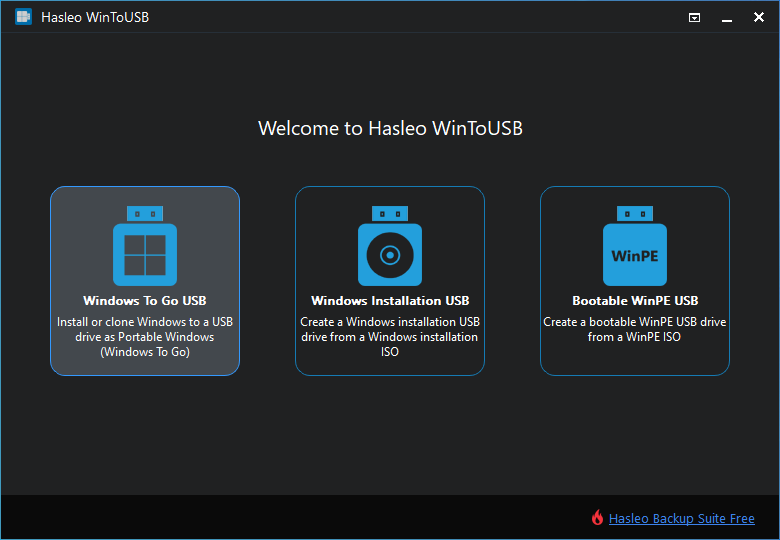
Step 1. Connect the USB drive to your computer, then download, install and run Hasleo WinToUSB. Click the "Windows To Go USB" option.
Step 2. Click "Select installation source" => "Browse image file". Then choose an image file (ISO/WIM/VHD(X)/DBI) from the dialog box as the installation source. Alternatively, you can select a CD/DVD drive with Windows installation media as the installation source.
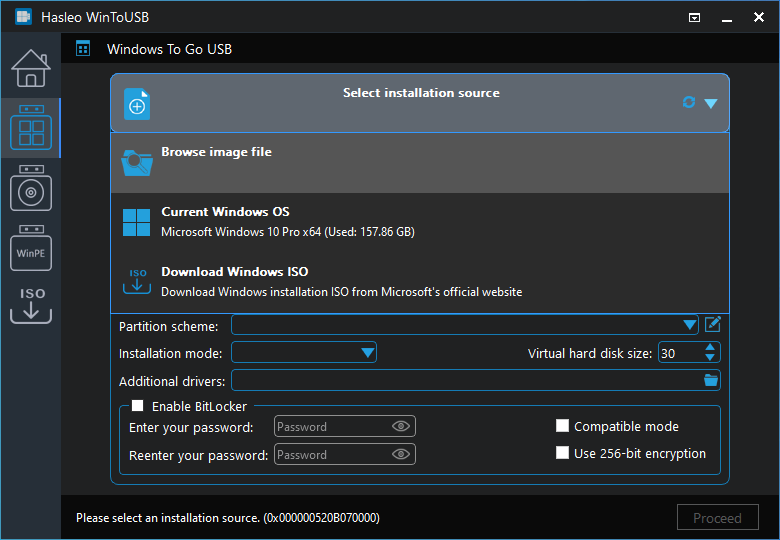
• You can also clone your current running Windows installation to a USB drive as a portable Windows workspace by selecting "Current Windows OS" as the installation source.
• The DBI is the extension for the backup image files generated by Hasleo Backup Suite.
Step 3. Hasleo WinToUSB will scan for and list the available operating systems. Please select your desired Windows edition here to proceed with the installation.
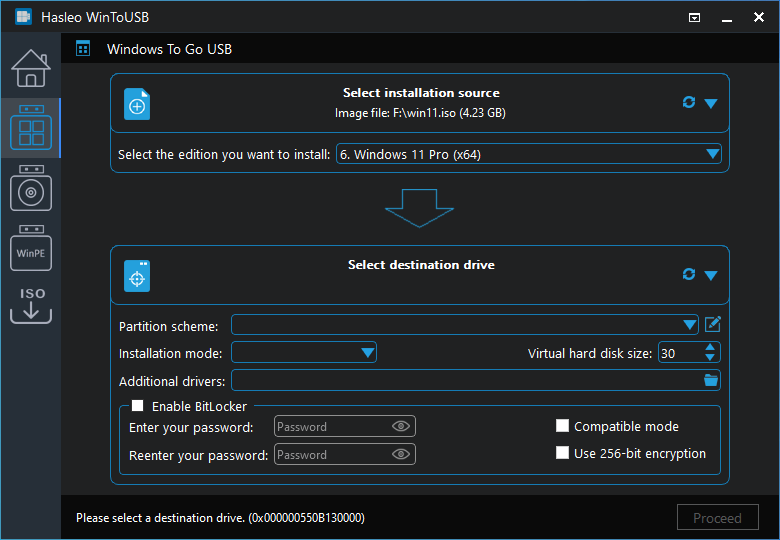
Step 4. Click "Select destination drive", then choose the target drive from the pop-up list. If Hasleo WinToUSB fails to detect the drive, click the  button to initiate drive recognition.
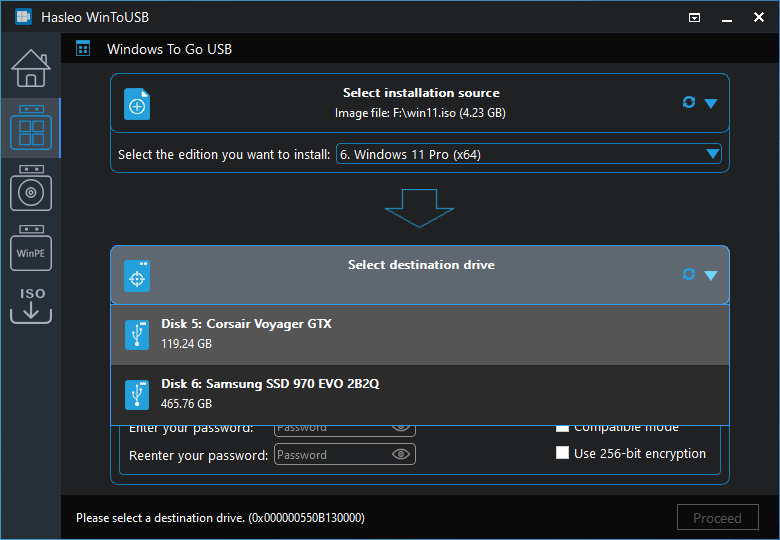
Step 5. Select your preferred partition scheme and installation mode. Optionally, you may specify additional drivers or enable BitLocker encryption for the Windows To Go drive, then click "Proceed".
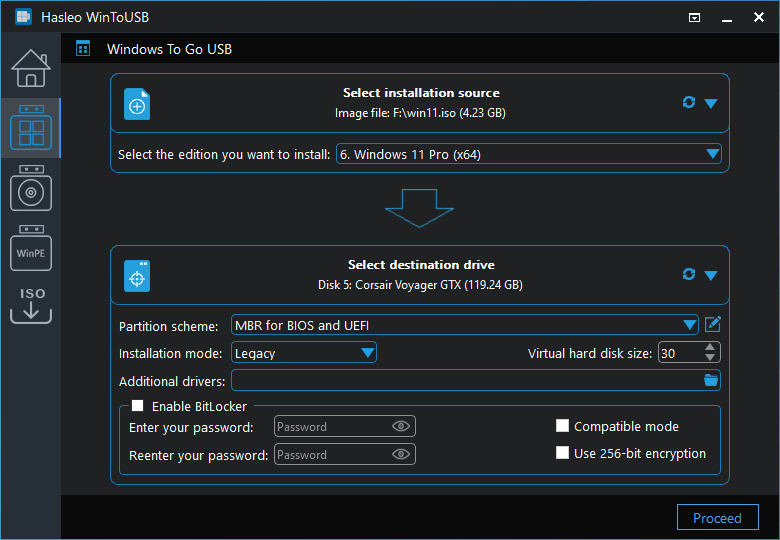
• For detailed information about "Partition scheme", "Installation mode" and "Enable BitLocker", please refer to: How to create Portable Windows 11/10/8/7 from ISO, WIM, ESD, SWM or VHD(X) files?
• If you select "Keep the existing partition scheme" option, you need to manually prepare the USB drive partitions before this step. View guide: How to Manually Prepare Partitions for Windows To Go.
Step 6. After clicking "Proceed", a confirmation dialog will appear asking whether to continue formatting the drive. Click "Yes" if you accept the operation.
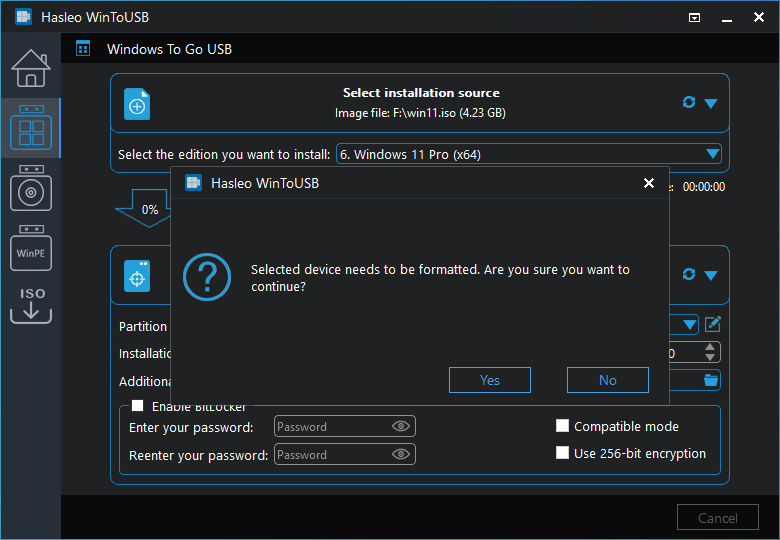
Step 7. After clicking "Yes", WinToUSB begins installing Windows to the destination drive.
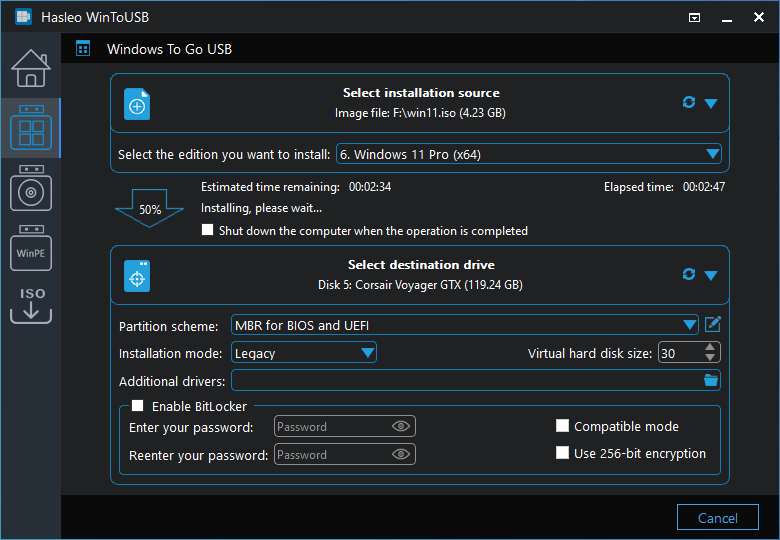
Step 8. The installation will take some time, so please be patient.
Boot and run Windows 11/10 directly from the portable USB drive.
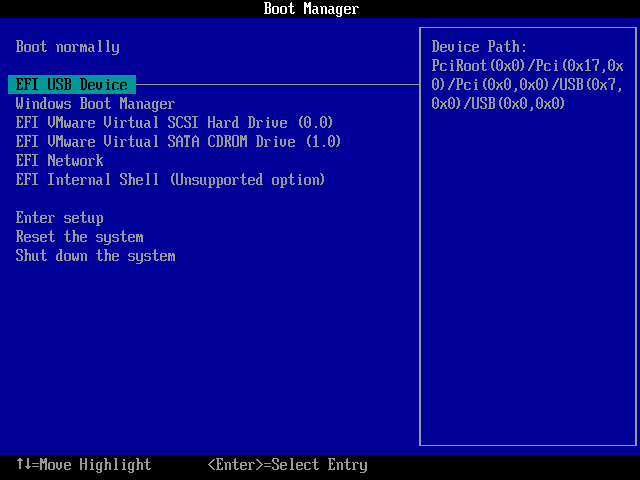
BIOS/UEFI settings allow you to run a boot sequence from floppy drives, hard drives, CD-ROM drives, or external devices. To boot a portable Windows from a USB drive, access the host computer's BIOS/UEFI settings and change the boot order to set the USB as the first boot device.
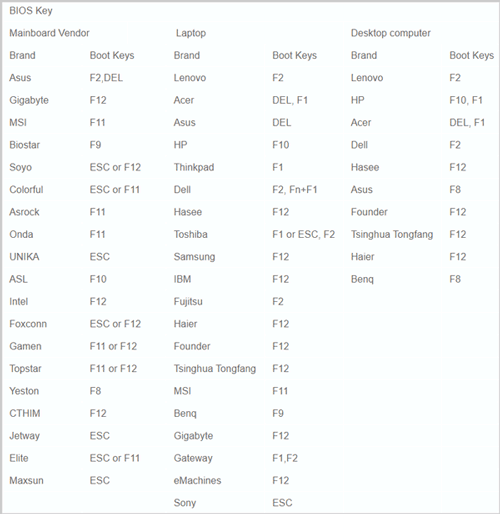
Step 1. After completing the installation, restart the computer and press the designated key to enter BIOS/UEFI setup. Note: The specific key varies depending on the motherboard manufacturer and computer model. During system startup, you are prompted briefly to press the BIOS/UEFI access key. Due to the short display duration, the prompts may be difficult to read. The following diagram displays BIOS/UEFI access keys for popular computer manufacturers and common motherboard brands.
Step 2. After accessing the BIOS/UEFI interface, change the boot order to prioritize your portable Windows 11/10 USB drive.
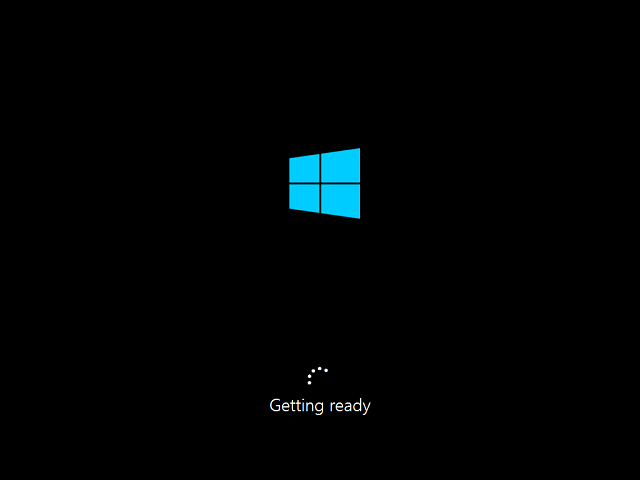
Step 3. A standard Windows 11/10 installation requires completing all setup steps during the first boot. Afterward, you can install applications and copy files, etc.
Why Choose Hasleo WinToUSB for Portable Windows Creation
While several tools can create portable Windows drives now, Hasleo WinToUSB stands out as the most comprehensive solution. It is the world's first third-party portable Windows creator and remains the only tool that supports all of the following:
- Create portable Windows from ISO, WIM, VHD(X), ESD, or CD/DVD
- Clone your existing Windows installation to a USB drive
- Create BitLocker-encrypted Windows To Go drives
- Update existing Windows To Go with Delta Clone technology
- Create portable Windows from Hasleo Backup Suite image files
- Create VHDX-based Windows To Go
- Work with all Windows editions (Home, Pro, Enterprise, Education, Server)
- Support both certified and non-certified USB drives
Other tools like Rufus, AOMEI Partition Assistant Free and EaseUS OS2GO offer basic Windows To Go creation, but they lack critical features such as BitLocker encryption, system cloning, and VHD(X) support. Here's a quick comparison:
| Feature | Hasleo WinToUSB | Rufus (Open source) | AOMEI Partition Assistant Free | EaseUS OS2GO |
|---|---|---|---|---|
| Create WTG from ISO/WIM/ESD | ✓ | ✓ | ✓ | ✓ |
| Create WTG from VHD(X) | ✓ | ✓ | ✗ | ✗ |
| Clone Running Windows to USB | ✓ | ✗ | ✓ | ✓ |
| BitLocker Encryption | ✓ | ✗ | ✗ | ✗ |
| Delta Clone (Update Existing WTG) | ✓ | ✗ | ✗ | ✗ |
| Create Windows Installation USB | ✓ | ✓ | ✗ | ✓ |
| Create WinPE Bootable USB | ✓ | ✓ | ✗ | ✗ |
As the comparison shows, Hasleo WinToUSB offers the most comprehensive feature set for creating portable Windows drives. For a more detailed comparison of free Windows To Go creation tools, please refer to: Top 3 Free Windows To Go Creation Software.
Troubleshooting Common Issues
Click the refresh button next to the drive list. If the drive still does not appear, reconnect the USB drive or try a different USB port (USB 3.0 recommended). Make sure the drive can be correctly recognized by the Windows Disk Management tool.
The last 8 characters of the error code shown by Hasleo WinToUSB correspond to the error code returned by the Windows kernel. 0x1B1 (A device which does not exist was specified.) typically means the disk was unexpectedly disconnected or went offline automatically. Try the following:
- Replace the data cable or enclosure
- Connect an external power supply to the USB drive
- Reconnect the USB drive or use a different USB port
- Perform the creation operation on another computer
The last 8 characters of the error code returned by Hasleo WinToUSB ending in 00000005 correspond to Windows error code 0x5 (Access is denied.) — this means the system denied write access to the drive. This is typically caused by antivirus software blocking the write operation. Try temporarily disabling your antivirus or adding WinToUSB to the exclusion list before retrying.
The speed of a USB 2.0 drive is very slow and is not suitable for creating Windows To Go. Please use a USB 3.0/3.1 drive or an external SSD and connect the USB drive to the computer's USB 3.0/3.1 port for better performance. Normally, the creation process only takes a few minutes, depending on the drive speed and Windows version.
Enter BIOS/UEFI settings and verify the boot order places your USB drive first. And make sure that the USB drive is connected directly to a USB port on the computer. Many computers don’t support booting from a device connected to a USB 3 PCI add-on card or external USB hubs.
Frequently Asked Questions
A: Yes, with Hasleo WinToUSB, you can create portable Windows on any USB drive, including non-certified drives. Microsoft's official Windows To Go required certified drives, but WinToUSB works with standard USB flash drives and external hard drives.
A: A portable Windows (Windows To Go) is a full Windows installation that runs from the USB drive—it includes all your files, applications, and settings. A Windows installation USB is used to install Windows on a computer and is wiped after installation. Portable Windows works exactly like a normally installed Windows system.
A: Yes, portable Windows created with WinToUSB can boot on most computers. However, some enterprise computers with strict security policies may not allow booting from external devices. The computer must support booting from USB and have compatible hardware.
A: Performance depends on your USB drive speed. USB 3.0 drives provide good performance similar to internal SSDs. USB 2.0 drives will be noticeably slower. For the best experience, use a USB 3.0/3.1 drive or external SSD.
A: Yes, you can install Windows updates on your portable Windows drive just like a regular installation. Major feature updates may require more time and free space. Some users prefer to recreate the portable Windows with a newer ISO for major updates.
Summary
This step-by-step tutorial guides you through creating a bootable portable Windows 11/10 workspace on a USB drive using Hasleo WinToUSB, complete with practical technical tips. The process is straightforward: simply prepare a Windows installation ISO (or DVD) and a compatible USB drive or external hard drive. Hasleo WinToUSB handles the rest, making it easy to build your own portable Windows system that you can boot on any computer.
Pro tip: For the best performance and user experience, we strongly recommend using an external SSD.
Related Guides
- How to create Windows To Go from VHD or VHDX file?
- How to create Windows 11 To Go (All Windows 11 editions are supported)?
- How to create Windows To Go compatible with UEFI CA 2023?
- How to Create Windows To Go from ISO for ARM64 Computers?
- How to clone Windows 11 to a USB drive as portable Windows 11?


